 3AM Marketer
How to Fact Check AI Content: 5 Editorial Rules
Google requires manual review of AI output before publishing, while frontier model reasoning error rates reach up to 48%. Here is the operational fact-checking protocol.
Google updated its generative AI documentation on October 1, 2026, explicitly stating that it is critical to manually fact-check and review all AI-generated content for accuracy and trustworthiness before publishing. Separately published research puts frontier model hallucination rates at 1% to 3% on basic summarization up to 48% on complex reasoning tasks.123

Isolate Quantitative Claims Against 48% Reasoning Error Baselines
Editorial audits must isolate factual statements through fractionation rather than treating model output as unified text. Fractionation breaks down responses into individual, searchable factual assertions. Editors must evaluate factual claims themselves by consulting independent external sources, because language models generate composites of multiple unidentifiable sources.7
Editors must also scan for internal contradictions, where an AI output presents a statement in one section that conflicts with statements made later in the same text.8
Cross-Reference Citations Directly Beyond 17% to 33% RAG Gaps
Retrieval-augmented generation tools in the legal sector continue to show hallucination rates ranging between 17% and 33% on benchmark queries.2
Verifying sources requires lateral reading, leaving the AI output to verify claims directly against primary records. Editors should check claims using Google results, Wikipedia, or fact-checking resources like Snopes, FactCheck.org, and PolitiFact. Verifying whether a referenced entity or research study actually exists requires consulting primary repositories like Google Scholar or UMD Discover.78
Audit Catalog Feeds, Schema, and IPTC Metadata
Editorial reviews must extend past visible text to structured metadata layers. For ecommerce sites, Google mandates that AI-generated product data such as titles and descriptions must be labeled as AI-generated. Image assets generated with AI require IPTC metadata fields, including DigitalSourceType set to TrainedAlgorithmicMedia, an enforcement standard live in Google Merchant Center since at least May 2025.46
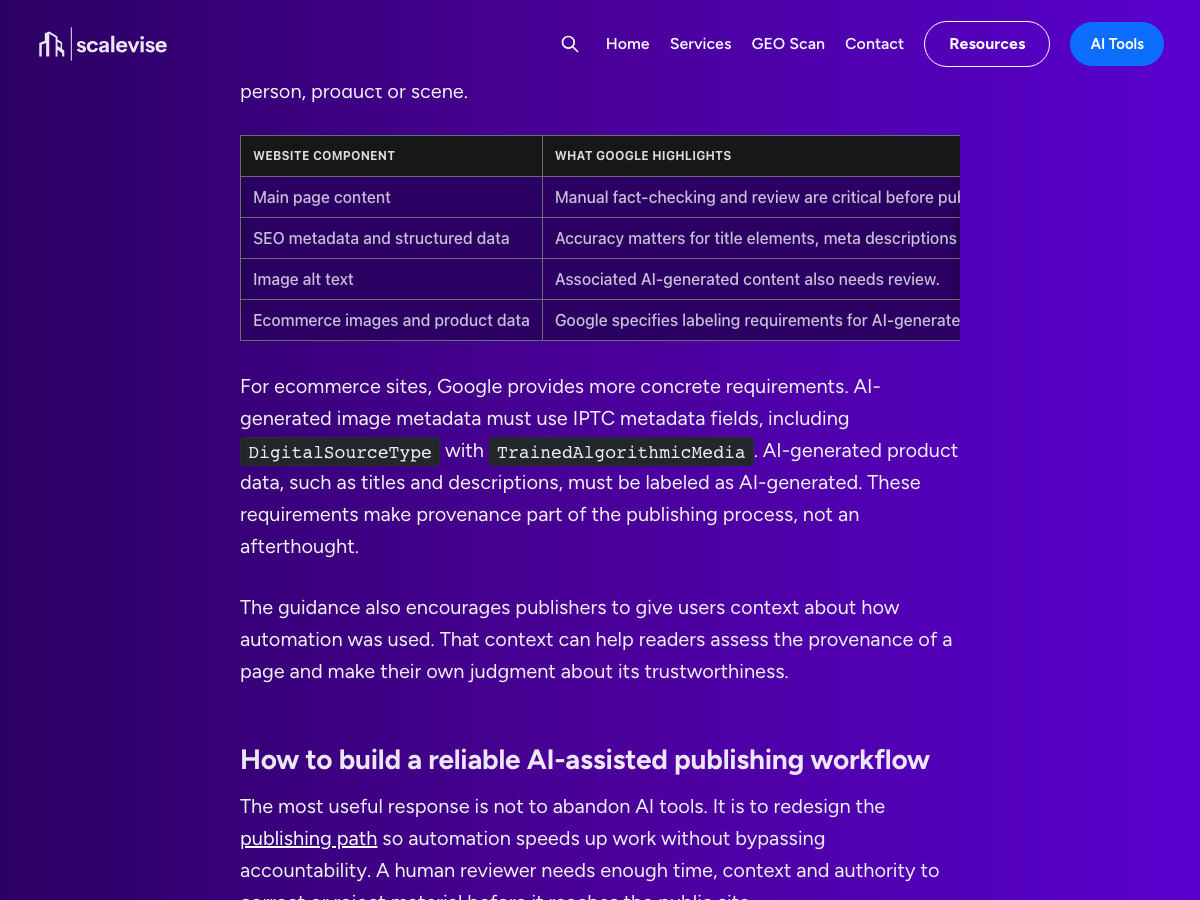
Auditing automated metadata surfaces requires sampling generated titles directly against target page content, running duplicate-description reports across site templates, and validating structured data in Google's Rich Results Test.6
| Content Surface | Auditing Action | Benchmark or Standard |
|---|---|---|
| Reasoning Copy | Fractionation and lateral reading against primary sources | 14% to 48% reasoning error baseline |
| RAG Outputs | Verification via Google Scholar, UMD Discover, or primary records | 17% to 33% legal benchmark hallucination |
| Ecommerce Feeds | Labeling AI product data; validating schema in Rich Results Test | Google Merchant Center requirements |
Strip Deceptive Personas and Enforce Authentic Attribution
Google's updated documentation explicitly defines deceptive authorship as a form of deception that makes a page untrustworthy to both users and automated quality systems. The guidelines identify AI-generated headshots, made-up names, and false credentials intended to simulate human expert authors as low-quality signals.3
Where AI tools cover specialized disciplines like law, medicine, or engineering, subject-matter experts must review drafts to avoid legal risks such as copyright infringement or false information.8
Operationalize Human Oversight to Protect Organic Traffic
The business impact of review workflows directly dictates search performance. Websites publishing 50 to 100 quality AI articles with human editing recorded search traffic increases of 30% to 80%. In contrast, websites publishing over 1,000 unedited AI articles saw traffic drops between 40% and 90%. Google evaluates main content quality and accuracy rather than relying on third-party AI detector scores.5
Questions
Can AI-generated content be detected by search engines?
Google does not use third-party AI detector scores as a ranking factor. Instead, Google evaluates the quality of main content based on effort, originality, talent or skill, and accuracy.
How do you verify AI-generated content?
Apply fractionation to isolate verifiable claims and conduct lateral reading by consulting external sources like Google Scholar, Wikipedia, and primary industry databases. Audits should also review schema markup, catalog descriptions, and IPTC image metadata.