 3AM Marketer
Meta Crawl Terms Update: Robots.txt and AI Access
Meta's revised Commercial Terms take effect on October 30, 2026, authorizing automated crawlers across sites associated with advertiser products.
The revised Meta Commercial Terms take effect on October 30, 2026, requiring every business using Meta's products to authorize automated software to access websites associated with its products or services. Consent under the updated agreement is entirely passive: continued use of any Meta Company Products for commercial purposes constitutes binding acceptance of the terms.1
The October 30 terms update: What changed
The revised terms grant Meta broad authority to deploy automated software such as crawlers and spiders across sites linked to commercial users. The clause also permits Meta to create test credentials to access and crawl these covered domains, though the contract does not explain what test credentials are or where they will be used. Following public backlash, Meta removed the word 'train' from the US English version of the document on October 17, 2026.12
Despite removing the explicit training verb, the amended text lets Meta use crawled material to provide, develop, improve, research, and maintain advertising and business products, while protecting the integrity and security of Meta Company Products. This definition of Meta Company Products encompasses the full suite of current and future Meta apps, websites, and AI systems such as Meta AI or the Meta Muse AI agent. The framework applies to running ads, marketing messages, listing items, managing a product catalogue, administering a Page, or using tools like Ads Manager and Meta Business Suite.321
Defining the scope of associated domains
The mandate applies broadly to any website associated with your products or services, but Meta leaves that phrase entirely undefined. For publishers whose commercial product is digital content, or brands operating distributed storefronts, this ambiguity leaves the boundary of covered URLs open to broad interpretation. In addition, the agreement specifies that Meta reserves the right to periodically pull updates from these destinations, establishing an ongoing crawl schedule rather than an isolated, one-off fetch.1
Managing Meta-ExternalAgent via robots.txt
Meta documentation indicates that website owners can continue using robots.txt to signal crawling preferences, denying that the updated terms supersede those controls. In practice, Meta-ExternalAgent is the specific crawler deployed to crawl the web for training foundation AI models or directly indexing web content. Blocking this specific bot remains the primary mechanism for preventing site data from being collected for AI training use cases, though publishers auditing bot traffic alongside a curated llms.txt validator should note the distinction between scraping directives.453
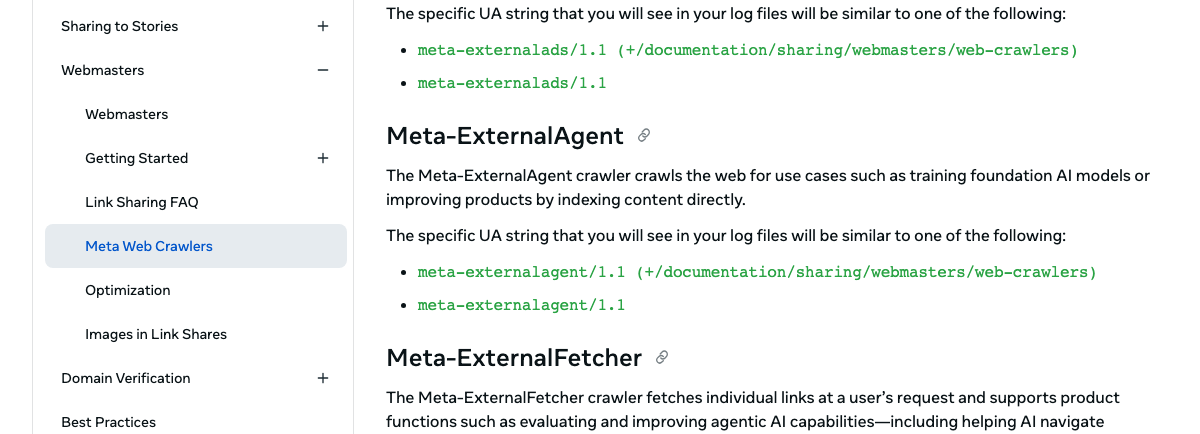
However, disallow directives do not restrict all Meta scrapers equally. The documentation confirms that Meta-ExternalFetcher and FacebookExternalHit may bypass robots.txt instructions when conducting security checks or completing user-requested link previews. Industry adoption of explicit exclusions remains low: a March 2026 sample of 4,047 robots.txt files parsed across Cloudflare's network found Meta-ExternalAgent named in only 3.82% of AI targeting disallow rules.56
The binary choice for business compliance
Meta provides no toggle within Ads Manager or Meta Business Suite to opt out of the crawling language while continuing commercial campaigns. Under the contract language, the only formal method to reject the terms is to stop all access or use of Meta products for business or commercial purposes. Teams maintaining business operations while assessing crawl patterns across search ecosystems, much like auditing visibility after a Google search ranking update, must rely on robots.txt disallow directives against Meta-ExternalAgent while monitoring fetcher bypasses across their properties.15