 3AM Marketer
ChatGPT Ads: Cost per Lead Data and Unit Economics
Longitudinal case study data reveals how ChatGPT ads crossover paid search efficiency over a 90-day evaluation framework.
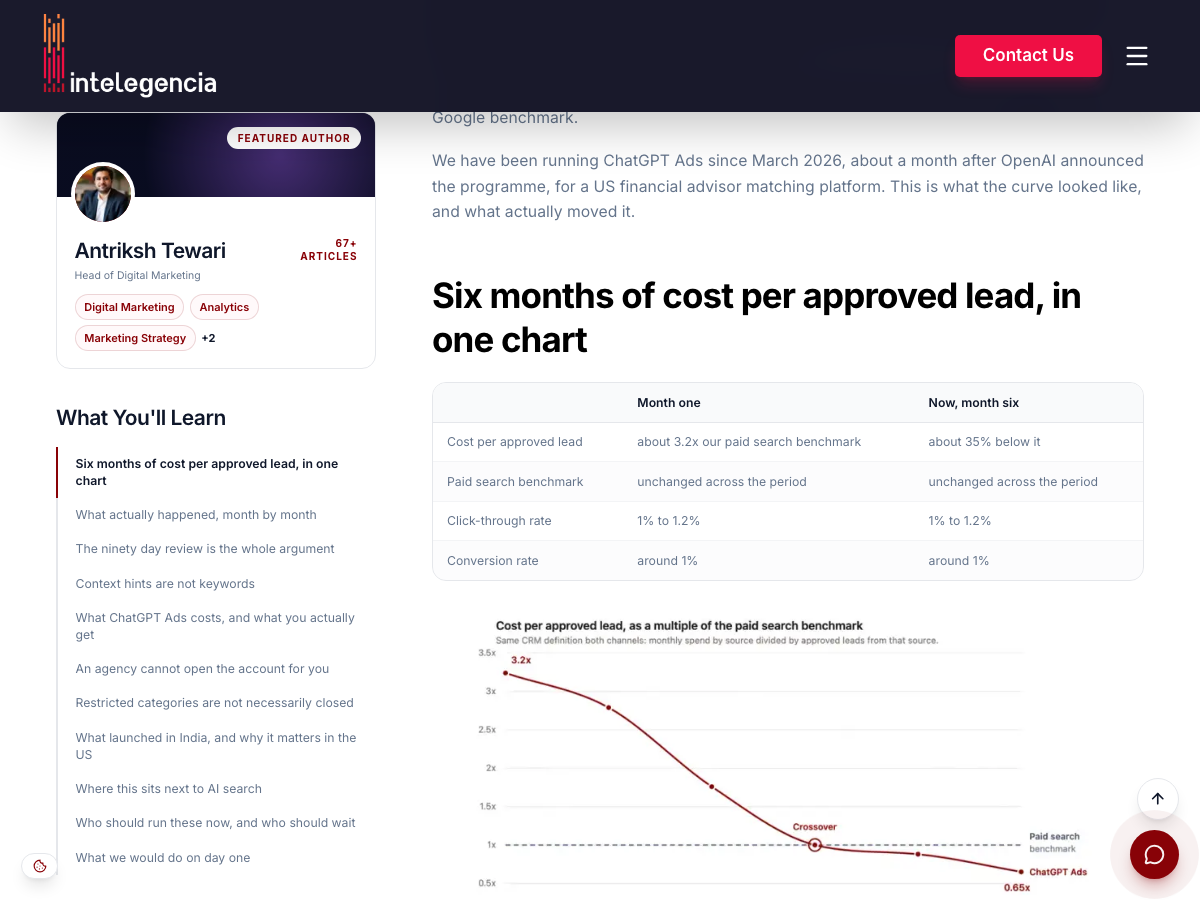
ChatGPT ads begin at roughly 3.2 times the cost per approved lead of paid search before crossing over and dropping 35 percent below search benchmarks after a 90-day evaluation period. While third-party benchmarks highlight a 0.21 percent conversion rate compared to 3.71 percent on Google Ads, longitudinal case data shows that conversational ad relevance requires multi-month contextual training rather than immediate keyword bidding.12
Why month one of ChatGPT ads looks like a failure
OpenAI announced ads for ChatGPT on January 17, 2026, delivering sponsored placements to Free and Go tier users. In an analysis of the rollout, ads target users aged 18 and older. As the platform expanded across its 800 million weekly active users, early performance metrics raised immediate concerns for performance advertisers.12
Search Engine Land reported a 0.21 percent ChatGPT conversion rate against 3.71 percent for Google Ads in August 2026. In an engagement the Publisher led for a US financial advisor matching platform, month-one performance reflected those numbers directly: the cost per approved lead came in at about 3.2 times the client's established paid search benchmark.1
Reviewing direct-response accounts at 14 or 30 days would prompt most teams to kill the campaign. During months one and two, acquisition costs plateaued as conversion tracking was treated as table stakes rather than the lever that moves efficiency. Contextual campaigns fail early because traditional advertisers expect algorithmic matching to deliver immediate parity without structured conversational briefs.1
The 90-day evaluation framework and cost crossover
Performance on conversational platforms follows a multi-stage trajectory rather than a linear slope. The Publisher's six-month case study demonstrated that month one and month two represented an extended plateau where cost per lead remained over triple the Google benchmark.1
Inflection occurred in month three. By the end of month four, cost per approved lead reached parity with the search baseline, stabilizing at roughly 12 percent under search before reaching approximately 35 percent below the search benchmark in month six.1
Click-through rate held flat between 1.0 percent and 1.2 percent across all six months, while the conversion rate hovered steadily around 1 percent. Efficiency gains did not stem from landing page redesigns or banner iterations, but from filtering into better-qualified conversations over time.1
Marketers must schedule a formal 90-day review before spending their first dollar. At 90 days, the campaign remained behind paid search, but the slope showed month-on-month improvement. When a campaign's acquisition costs remain flat at day 90, the problem is structural; when costs are steadily falling, crossover follows within 30 days.1
Targeting through context hints instead of keyword lists
ChatGPT Ads eliminates keyword fields entirely. Targeting relies on a freeform ad group text box where media buyers describe the conversation the product belongs in, alongside geographic settings and first-party customer audience lists.1
Pasting keyword lists into this field degrades ad delivery. In the Publisher's case study, compiling comma-separated terms like fiduciary financial advisor, fiduciary near me, fee only fiduciary, and fiduciary advisor cost produced ineffective matching. Effective ad groups require brief-style descriptions detailing buyer circumstances and financial thresholds.1
The winning context hint outlined specific buyer circumstances: people asking what a fiduciary financial advisor is, whether their current advisor is a fiduciary, and how to find a registered fiduciary, specifically those with $250K+ invested seeking advice legally required to be in their interest. The setup works best when teams keep hints to roughly 280 characters, stick to one theme per ad group, match the landing page directly to the hint's framing, and mirror hint phrasing in the ad copy itself.1
Platform mechanics, inventory buying, and technical constraints
Account structure follows a standard Campaign, Ad Group, and Ad hierarchy. Advertisers can choose standard builds or product feeds, supporting Reach on a CPM model, Clicks on a CPC model, and Conversions. Cost-per-click typically falls between $2 and $5, with bids below $3 frequently failing to deliver impressions.1
Creative specifications require a 50-character headline, a 100-character body copy, and a minimum 256 by 256 pixel square image. Single centered images clearly conveying the offering outperform complex infographics. The interface occasionally triggers an erroneous red text-truncation warning on headlines as short as ten characters, which advertisers can safely bypass if copy remains within official limits.1
Measurement relies on the native OpenAI pixel alongside standard UTM tagging. Amazon Ads partnered with OpenAI to sell ChatGPT ad placements through its platform in a pilot for U.S. advertisers, joining external adtech partners such as Criteo, Kargo, Adobe, Pacvue, and StackAdapt, with Delta Vacations among the initial trial brands.13
Sensor Tower tracked a 163% increase in ads served per user per hour spent on ChatGPT in the U.S. in August compared to April, while active advertisers reached 1,200 brands in August, expanding 43% month-over-month since May.3
Account governance, restricted categories, and testing in India
Agencies cannot create ChatGPT Ads accounts on behalf of clients. Brands must establish accounts directly under their registered legal business entity and tax ID, granting access to agency partners afterward. This rule enforces direct client billing and clean asset retention.1
Restricted categories such as financial services, adult, alcohol, tobacco, and gambling are subject to manual review rather than outright prohibition. In the Publisher's deployment, securing approval required direct customer support engagement alongside formal endorsement from a US partner.1
OpenAI introduced the ChatGPT Ads self-serve manager in India on September 4, 2026, with launch partners including WPP and Omnicom. The minimum daily spend in India is 725 rupees (roughly $7.60), compared to the $25 daily minimum required in the United States. Advertisers with an Indian legal entity can refine context hints at roughly one-third of US testing costs before carrying what they learn into a US account.1
Marketers evaluating conversational media should review their analytics infrastructure before bidding. Review our framework on how to rank in ai overviews to address organic AI visibility, and align testing windows with multi-touch attribution before spending begins.1
Questions
Does ChatGPT have ads?
Yes. OpenAI delivers sponsored ads to free tier users and ChatGPT Go subscribers aged 18 and over, labeled clearly below assistant responses.
How much do ChatGPT ads cost?
Average cost per click runs between $2 and $5, with bids below $3 frequently failing to deliver impressions. Minimum daily spend is set at $25 in the United States and 725 rupees (around $7.60) in India.
Can ChatGPT ads influence the organic text responses generated by the AI?
No. Ads appear in designated sponsored slots beneath answers, and OpenAI does not permit advertisers to pay to alter conversational text.