 3AM Marketer
Google and Microsoft Split AI Training Controls
Microsoft launched controls splitting AI training from search grounding, while Google announced plans to support the unified AIPREF standard in early 2027.
Microsoft introduced new Bing AI content controls on October 30, 2026, allowing site owners to separate AI training from AI search grounding while preserving standard Bing search eligibility. Google followed by announcing plans to adopt an Internet Engineering Task Force (IETF) standardized AI training control in early 2027 that will manage preferences across multiple AI providers in a single step.12
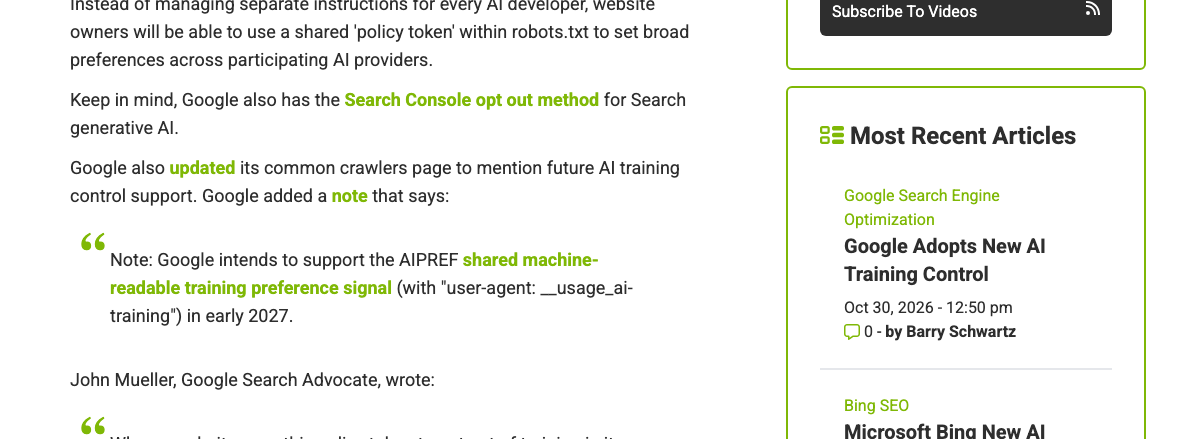
SCREENSHOT: Search Engine Roundtable reports on Google's planned adoption of the unified IETF AIPREF machine-readable signal.2
Understanding the new AI control framework
The search platforms are formalizing a split between using web content for foundational model training and accessing content for real-time retrieval-augmented generation. Under Microsoft's framework, publishers can block their content from being used to train AI models while still allowing systems like Copilot to cite those articles in AI-generated answers. This distinction ensures webmasters can safeguard proprietary content without disappearing from conversational discovery interfaces.1
Implementing Bing's three ingestion controls
Microsoft's update establishes three distinct settings for web content: an AI Training setting to permit or block content use in model training, an AI Grounding setting to govern whether content helps generate AI answers, and a Limited Grounding setting. The Limited Grounding option allows web content to support Microsoft's internal AI products while actively blocking access to its third-party grounding services.1
Preparing for the unified AIPREF standard
In parallel, Google plans to adopt the machine-readable training preference signal developed by the AIPREF working group at the IETF. Set for rollout in early 2027, the standard uses the robots.txt directive "user-agent: __usage_ai-training". When a site uses this policy token without an explicit Google-Extended rule, Google will interpret the opt-out directive as if the publisher had disallowed Google-Extended, while existing company-specific controls will continue functioning alongside it according to crawler specifications.23
Publisher timeline and compliance deadlines
Publishers navigating these updates must track four implementation milestones. On December 15, 2026, temporary grounding controls will arrive in Bing Webmaster Tools for sites relying on older NoArchive or NoCache directives. Microsoft begins honoring the new preference structure during crawl runs on February 1, 2027. Publishers using legacy directives have until March 1, 2027, to configure new preferences to preserve existing restrictions, after which temporary Bing grounding preferences expire on September 30, 2027.1