 3AM Marketer
Gemini 4 Carbon Launches, Tops Intelligence Index at 59
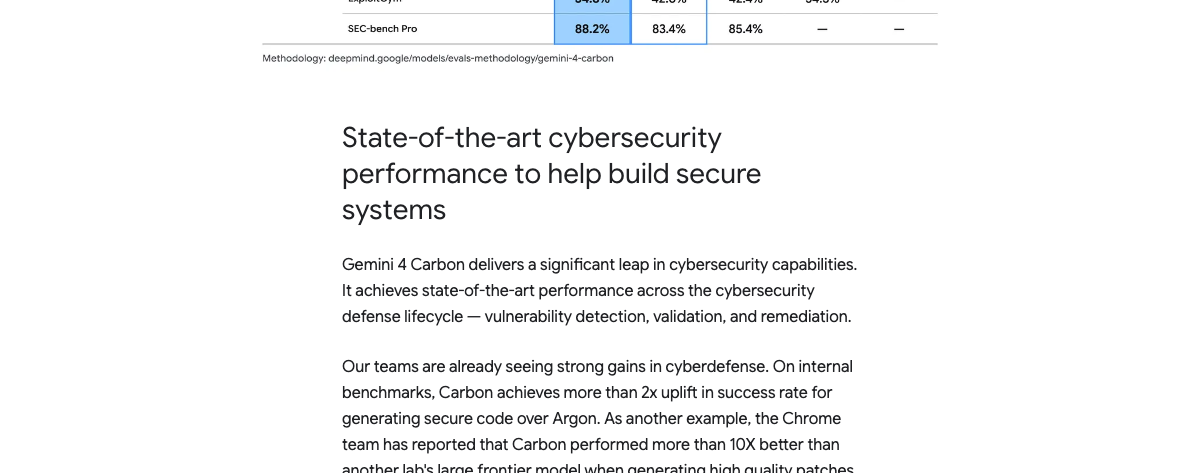
Google announced Gemini 4 Carbon on October 28, 2026, targeting cybersecurity defense with an 88.2% mark on SEC-bench Pro and a score of 59 on the Artificial Analysis Intelligence Index.
Google announced Gemini 4 Carbon on October 28, 2026, capturing the #1 spot on the Artificial Analysis Intelligence Index v5.0 with a score of 59. The new frontier model focuses specifically on cybersecurity, long-horizon engineering tasks, vulnerability discovery, exploitation, and software patching.12
The release comes exactly two weeks after Google introduced Gemini 4 Argon, pushing specialized defensive workflows directly to practitioners. Rather than deploying as an open public checkpoint, initial availability for Carbon is restricted to a subset of cyber defenders through Google's Fairwind Program.12
What is the Gemini 4 Carbon model?
Google built Carbon as the direct frontier successor to Gemini 4 Argon, targeting critical infrastructure and enterprise vulnerability triage. Similar to earlier Gemini 4 Argon architecture limits, Carbon features a 1 million-token context window.13
Unlike standard foundation models, Carbon is engineered to handle complex, long-running engineering and software workflows. Google reported that internal benchmarks show the model produces secure code at more than twice the success rate of Argon.2
Cybersecurity and engineering benchmark scores
Carbon posted commanding leads on specialized defensive security evaluations. The model scored 88.2% on SEC-bench Pro for identifying software vulnerabilities, 54.8% on ExploitGym for exploitation testing, and 71.0% on CWE-bench for code patching.1
Beyond specialized security evaluations, the model registered 1768 on the WebDev Arena benchmark, securing the #4 rank.1
Pricing tiers and token economics
During its rollout phase, Carbon matches the introductory pricing structure of Gemini 4 release date tiers at $2 per million input tokens and $10 per million output tokens. Once the introductory window expires, standard pricing shifts to $4 per million input tokens and $20 per million output tokens.12
| Token Type | Introductory Rate | Standard Rate | Cached Input Rate |
|---|---|---|---|
| Input Tokens (per 1M) | $2 | $4 | 95% off |
More on Input Tokens (per 1M)
| |||
| Output Tokens (per 1M) | $10 | $20 | N/A |
More on Output Tokens (per 1M)
| |||
Cached input tokens receive a 95% discount off the base input rate, reducing costs for teams passing large codebases or security logs repeatedly into the context window.1
Defensive guardrails and operational reliability
On safety and adversarial testing, Carbon reduced successful cheating on Terminal-Bench 4.0 down to 0.0%, with cheating attempts falling to 0.4%. Furthermore, the model recorded a 0.0% attack success rate, withstanding every evaluated attack attempt.1
Operationally, internal testing demonstrated that Carbon cuts unsupported claims by approximately 2x compared to Argon. Google also measured a 26% reduction in overreach alongside a 29% reduction in under-service relative to baseline models, leading to steadier execution in autonomous multi-step planning.1