 3AM Marketer
Google November 2026 Core Update: 2-Week Rollout
Google launched the November 2026 core update on November 10, with a rollout window of up to 2 weeks that overlaps Black Friday and Cyber Monday.
Google began rolling out the November 2026 core update globally across all languages on November 10, 2026, with a rollout window of up to 2 weeks. The update is designed to surface relevant, satisfying content from all types of sites and impacts Search, Google Discover, and featured snippets. Because the rollout concludes around Thanksgiving, it overlaps directly with Black Friday and Cyber Monday, amplifying traffic risk for publishers and retailers during the biggest shopping season of the year.12

The November 2026 update window and search volatility
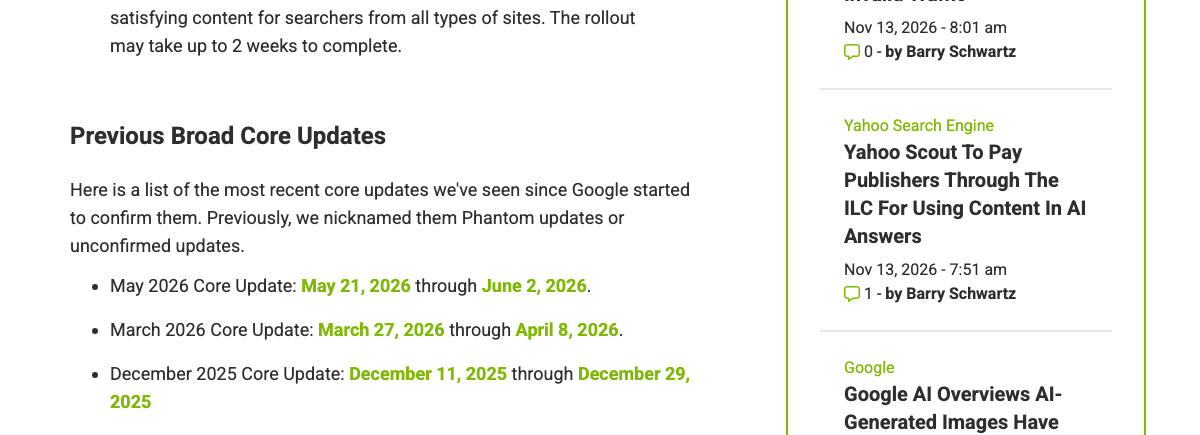
Google typically deploys 2 to 4 core updates per year, clustered in late Q1, mid-year, and late Q3 or Q4. This November 2026 release follows Google Search volatility in October 2026.23
How to audit ranking drops after the rollout
Site owners who see ranking drops should audit their pages to identify which URLs were most impacted and for what types of search queries. Rather than chasing one or two isolated metrics, Google advises aiming for an overall great page experience across many factors.4
Start by checking technical access and policy compliance. A 'Blocked by robots.txt' status means your crawl rules prevent Google from reading a page, while violating spam policies can trigger manual actions that lower rankings or exclude a site entirely. Verify that your mobile site is sound, as Google uses mobile-first indexing to rank pages. Dynamic elements like tabs and accordions do not violate spam policies, and paywalled content is not treated as cloaking if Google can read the full text under Flexible Sampling guidance.567
Evaluating YMYL content through E-E-A-T
Google's systems prioritize E-E-A-T (Experience, Expertise, Authoritativeness, Trust), with trust serving as the most important component. For YMYL (Your Money or Your Life) topics that affect health, financial stability, or safety, Google assigns even more weight to strong E-E-A-T signals. Note that search quality rater data is not used directly in ranking algorithms; instead, Google uses it as feedback to confirm whether its systems are working.4