 3AM Marketer
Pika H3 Flex Launches: 6-Step Open Source Video Model
Pika H3 Flex is now open source, offering 24 fps video with synchronized 32 kHz stereo audio and 12-reference multimodal conditioning in six sampling steps.
Pika H3 Flex launched as an open-source video model, generating 24 fps video with synchronized 32 kHz stereo audio in six sampling steps. The release introduces native open weights for local workstations alongside a cloud pathway that scales to 4K resolution.12
Understanding the H3 post-trained architecture and adapters
Pika H3 Flex operates as a post-trained version of the H3 architecture designed for speed and control. The model splits multimodal conditioning between two dedicated task adapters: FL2VA handles text prompts and endpoint-frame conditioning, while Ref2VA manages multi-reference assets.1
Production specs: 32 kHz audio and 12-reference inputs
The model generates 24 fps video with 32 kHz stereo audio mixed directly into the final render. Durations can be requested as integers between 5 and 15 seconds, with final runtime adhering to the model frame grid. Its Ref2VA adapter ingests up to 12 reference files across modalities: up to 9 images, 3 video clips, and 3 standalone audio files.1
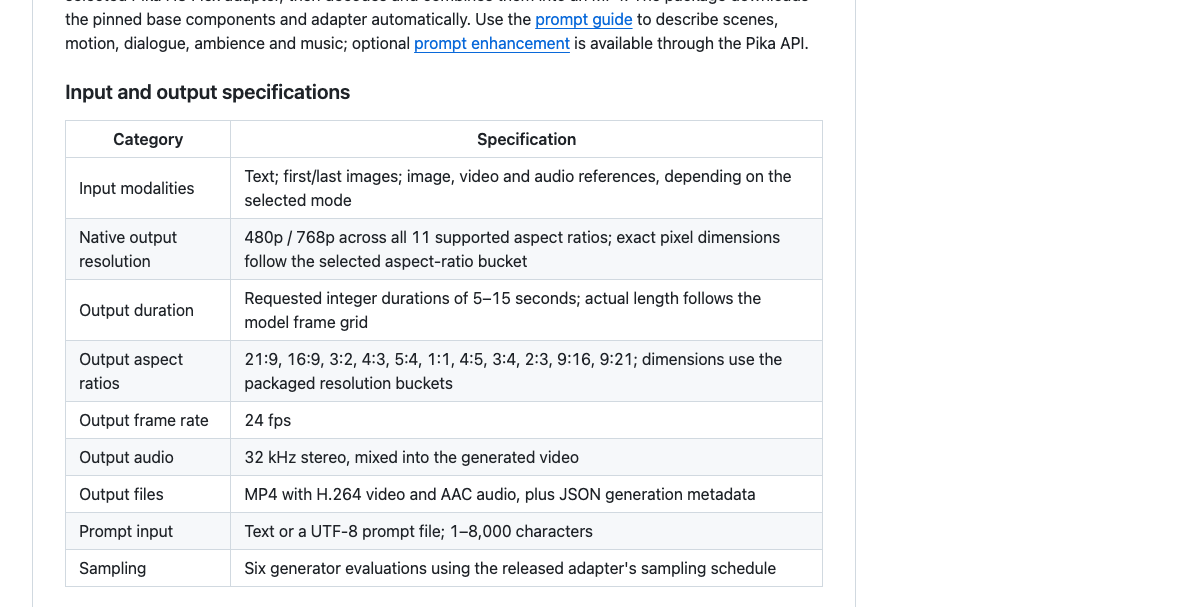
These controls are optimized for multi-shot storytelling, motion graphics, reference-guided animation, and product film pipelines.1
Local GPU requirements versus hosted 4K API limits
Local execution requires Python 3.12, an NVIDIA GPU, and compatible system drivers. Representative local workloads are tested on a single H100 80GB GPU per request. In contrast, Pika’s hosted API extends generation beyond the local 768p ceiling up to 1080p, 2K, and 4K video, while offering optional audio stem separation and prompt enhancement features.1
ComfyUI, Diffusers, and developer integration pathways
Pika provides out-of-the-box integration with ComfyUI and Diffusers, with code published on GitHub and weights hosted on Hugging Face.2