AI Agents for Business: Real Pricing and Loops
A factual breakdown of commercial AI agent pricing architectures, quota limits, mandatory overage mechanics, and human handoff rules.
Commercial AI agent platforms charge through three distinct pricing models: variable task credits, billable human-routed conversations, and flat per-session fees. While traditional software licenses charge predictable per-seat monthly rates, deploying dynamic AI agents introduces usage tiers where a single automated workflow can consume from 2 to 2,500 credits or trigger non-optional auto-purchases when reaching 95 percent of account capacity.12
The Observe-Plan-Act Dynamic in Business Workflows
Autonomous agents differ fundamentally from deterministic workflow builders. AI agents operate through a continuous observe-plan-act cycle, using large language models for planning while accessing connected external systems to take direct action and accomplish designated goals. In an industrial goods deployment evaluated by BCG, embedding agentic AI into daily supply chain workflows yielded a 2 percentage-point EBITDA boost across two years.3
Platform architectures split into fixed logic paths and dynamic autonomous agents. Gumloop separates its workflow features into canvas-based Flows, where users link tools in visual logic chains, and autonomous Agents that rely on natural language instructions and tool connections to adapt during execution. Gumloop provides a Free plan with 5,000 monthly credits and a $37 per month Pro plan that delivers over 20k+ credits per month, Model Context Protocol (MCP) server support, and bring-your-own API key options.4
Comparing Pricing Models: Task Credits vs Conversations
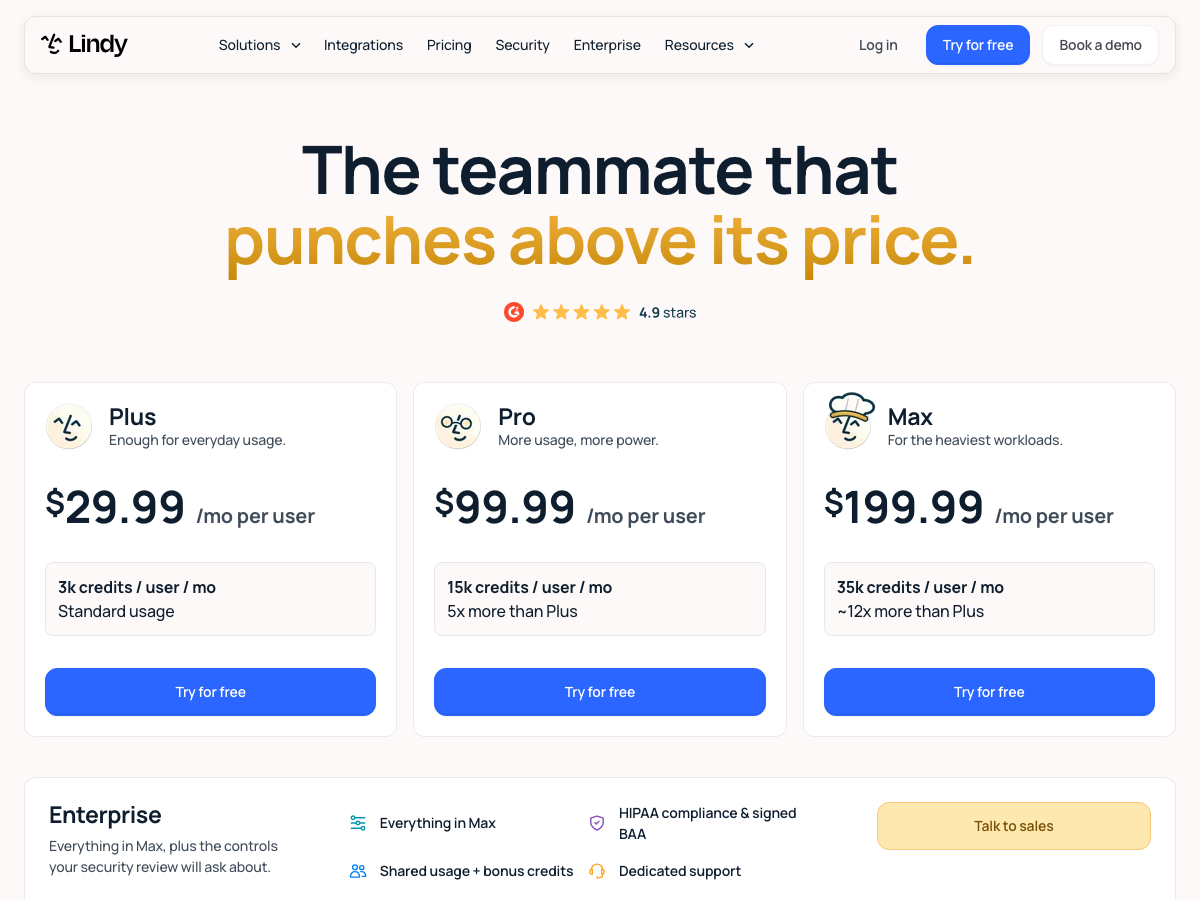
Agent vendors adopt vastly different billing units to account for model reasoning and tool execution. Lindy relies on a tiered task-credit structure across its subscription plans.1
Lindy charges $29.99 per user per month for Plus (3k credits per user per month), $99.99 for Pro (15k credits per user per month), and $199.99 for Max (35k credits per user per month). Routine lookups, summaries, or meeting wrap-ups consume 2 to 250 credits. Deep work tasks like competitor research reports or support queue triage cost 250 to 1,000 credits. Big builds like dashboards and complex workflows consume 1,000 to 2,500 credits.1
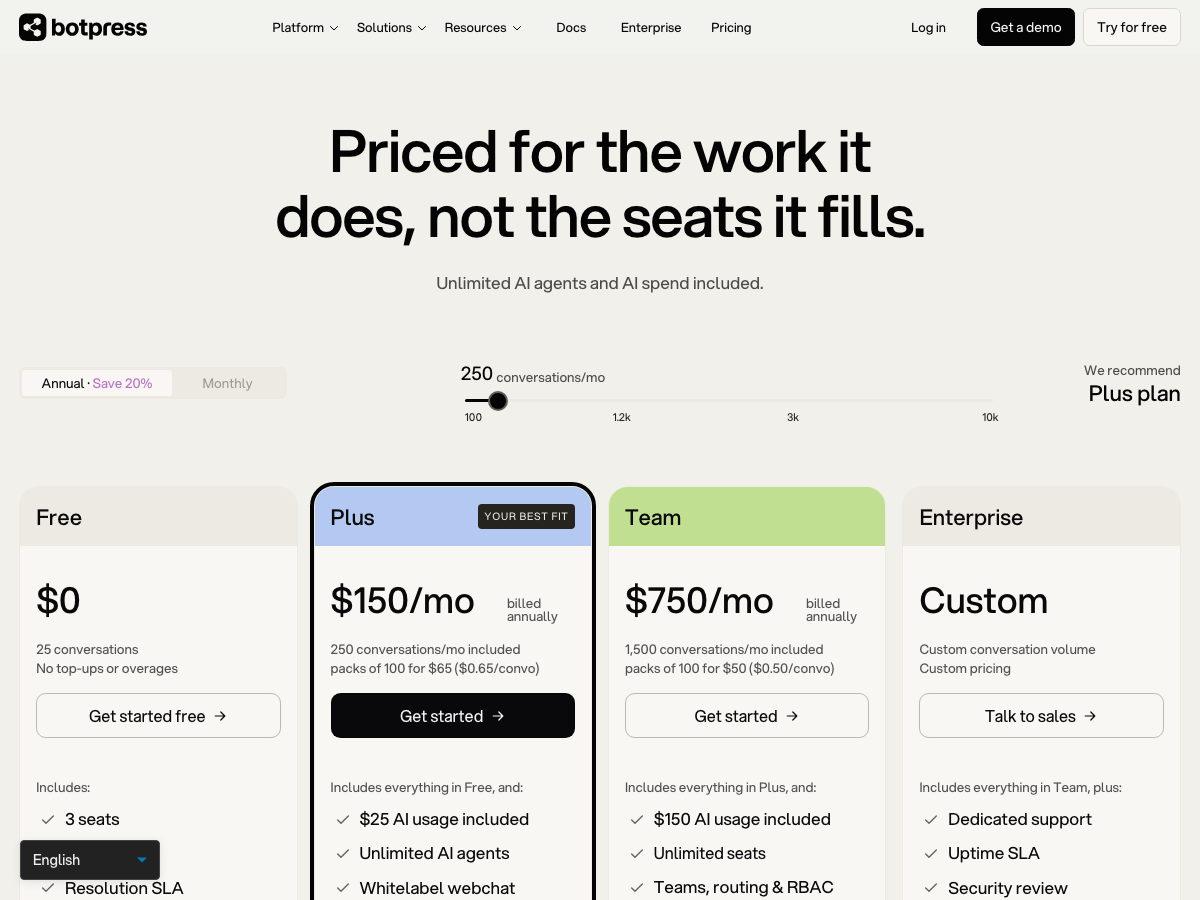
In contrast, Botpress structures billing around active conversations. A conversation is defined as any exchange containing at least two messages from an end user within the billing month, or three minutes of voice calls. Botpress provides a Free tier with 25 conversations, a Plus plan at $150 per month (billed annually) with 250 conversations, and a Team plan at $750 per month (billed annually) with 1,500 conversations. Every conversation includes $0.10 of AI spend covered by the platform.2
| Platform | Base Price | Included Units | Billing Metric | Overage Policy |
|---|---|---|---|---|
| Lindy (Plus) | $29.99/user/mo | 3k credits | Task credits (2-2,500/task) | Pauses execution; zero surprise billing |
| Botpress (Plus) | $150/mo (billed annually) | 250 conversations | Conversations (2+ user messages) | Auto-adds 100 convos ($65) at 95% capacity |
| eesel AI | Pay-as-you-go | No monthly minimum | Flat resolution-agnostic fee | No platform fee or monthly minimums |
Hidden Overage Mechanics and Quota Limits
Lindy pauses execution at zero credits: when workspace credits run out, credit-using actions pause until the next billing cycle resets them, preventing unexpected overage fees. Unused Lindy credits do not roll over month-to-month, and teammates invited through Slack receive a 7-day free trial before seat billing starts.1
Botpress takes the inverse approach with non-optional auto-purchases. When an account reaches 95 percent of its conversation quota, Botpress automatically adds a 100-conversation pack ($65 on Plus, $50 on Team) that cannot be toggled off, and it purchases a $10 credit grant of AI spend at cost when the workspace reaches 95 percent of its AI spend limit.2
Human Handoff Triggers and Resolution Guarantees
Some customer service platforms base their billing entirely on human intervention. Tidio offers a Starter plan at $24.17 per month for 100 billable conversations and Growth at $49.17 per month for 250 billable conversations. Crucially, Tidio defines a billable conversation strictly as an interaction that includes a message from a human agent, explicitly excluding responses generated by automated Flows or the Lyro AI Agent.6
For enterprise support, Tidio Plus starts at $300 per month plus monthly usage, allowing teams to pay separately for AI and human interactions. On Premium tiers covering from 3 000 Lyro AI conversations, Tidio shifts to pay-per-resolution billing backed by a guaranteed 50% Lyro AI resolution rate.6
Other operational agents avoid outcome-based thresholds entirely. eesel AI bills $0.40 per regular support ticket or chat session and $4 per generated blog draft on pay-as-you-go. Crucially, eesel AI charges for tasks regardless of whether the customer was satisfied or the issue was fully resolved, but eliminates base subscription fees and monthly minimums.5
Administrative Governance: Approvals and Infrastructure
Controlling what an agent does externally requires structural approval gates. Lindy mandates that any action with outside impact, such as sending an email, updating a support ticket, posting to an external channel, or publishing a document, must wait for explicit human approval. Read-only lookups from approved sources proceed without approval gates. Lindy maintains SOC 2 and GDPR compliance, encrypts data, does not train models on customer content, and signs BAAs for HIPAA compliance on Enterprise plans.1
For teams using base models directly, Anthropic provides Claude Pro at $17 per month billed annually ($200 up front) or $20 monthly, and Claude Max starting from $100 per month for 5x or 20x Pro usage. For team deployments, Claude Team costs $20 per seat per month billed annually ($25 monthly) for Standard seats and $100 per seat per month billed annually for Premium seats. Claude Team accounts do not train models on customer content by default and offer context windows scaling up to 1 million tokens depending on the model.7
Before choosing an AI agent platform, map your workload to the billing unit. If workflows involve unpredictable reasoning loops across external APIs, platforms with hard usage pauses like Lindy prevent billing surprises. If building dedicated support desks where agents resolve predictable inquiries, Tidio's human-message exemption or Lyro's 50 percent guaranteed resolution contracts mitigate runaway token costs.
Questions
What is the best AI agent for business?
The best platform depends on your operational billing model. Lindy suits internal autonomous tasks with credit tiers from $29.99 per month and hard spending caps, while Botpress and Tidio Lyro serve customer-facing chat operations with dedicated conversation metrics.
How do AI agent platforms bill for overages?
Billing mechanics split between strict cutoffs and automatic top-ups. Lindy pauses all credit-using actions without surprise fees when limits are reached, whereas Botpress automatically purchases a 100-conversation pack ($65 on Plus, $50 on Team) at 95 percent of its conversation quota, and a $10 AI credit grant at 95 percent of its AI spend limit.
How can I use AI agents in my business?
Businesses deploy agents for customer support triage, internal data lookups, and multi-step workflow automation. Platforms integrate with connected systems via APIs or MCP servers, executing observe-plan-act cycles with explicit approval gates for external actions.