 3AM Marketer
Autonomous AI Agents: Loops, Runtimes, and Pricing
A technical breakdown of autonomous AI agent loops, reasoning benchmarks, framework orchestration architectures, and production token pricing.
Autonomous AI agents execute actions independently by coupling large language models with persistent state and continuous feedback loops. Unlike standard conversational interfaces, autonomous architectures execute an iterative sense-think-act-learn cycle that validates intermediate steps against verifiable benchmarks and tool execution environments.12
The sense-think-act-learn cycle and lifecycle phases
An autonomous agent operates in a continuous control cycle that separates environmental perception from tool execution. The agent senses its environment or active task, applies AI reasoning logic to plan or decide, acts independently, captures feedback from system signals and user responses, and evaluates those outcomes to adjust future behavior. Understanding ai agent orchestration requires mapping this operational loop directly to underlying state graphs.1
Moving from a prototype agent to production involves an eight-phase development lifecycle. Engineering teams progress through goal definition, workflow design, prototyping, training on realistic patterns, testing on batch edge cases, pilot deployment, iterative prompt and logic adjustments, and finally scaling across multiple tasks.3
Reasoning architectures: ReAct vs Reflexion on benchmarks
Standard prompting often degrades as task complexity increases, which led to the creation of specialized reasoning architectures. The ReAct framework generates reasoning traces and task-specific actions in an interleaved fashion, creating synergy between internal reasoning and external environment interaction. When applied to question answering on HotpotQA and fact verification on Fever, ReAct mitigates hallucination and error propagation by interacting with a simple Wikipedia API.4
On interactive decision-making benchmarks, ReAct outperforms imitation and reinforcement learning baselines by absolute success rates of 34% on ALFWorld and 10% on WebShop when prompted with one or two in-context examples. Rather than requiring parameter fine-tuning, this setup allows models to navigate multi-step environments using structured action-observation steps.4
Reflexion expands this loop by reinforcing language agents through linguistic feedback rather than weight updates. Reflexion agents verbally reflect on task feedback signals and maintain their reflective text inside an episodic memory buffer to guide subsequent trials. On the HumanEval coding benchmark, Reflexion achieves a 91% pass@1 accuracy, surpassing GPT-4's baseline performance of 80%. When evaluating best ai coding tools 2026, verbal self-reflection mechanisms account for substantial leaps in single-pass code synthesis accuracy.2
Orchestration runtimes: LangGraph, AutoGen, and CrewAI
Selecting an execution runtime dictates how agent state is maintained, how tools are invoked, and how deterministic control flow interacts with model generation. Production frameworks offer divergent abstractions for handling distributed state and tool sandboxes. Evaluating building ai agents frameworks involves matching these execution models to organizational infrastructure.567
| Framework | Primary architecture inspiration | Language / runtime requirements | Key orchestration capabilities |
|---|---|---|---|
| LangGraph | Pregel and Apache Beam (NetworkX API) | Low-level orchestration runtime | Interleaves deterministic hand-coded steps with LLM agentic steps; working and long-term memory |
More on LangGraph
| |||
| AutoGen (AgentChat) | Conversational multi-agent core | Python 3.10+ | McpWorkbench for MCP servers; DockerCommandLineCodeExecutor for containerized code execution |
More on AutoGen (AgentChat)
| |||
| CrewAI | Role-based multi-agent processes | Python framework | Sequential, hierarchical, or hybrid execution; guardrails, callbacks, and human-in-the-loop triggers |
More on CrewAI
| |||
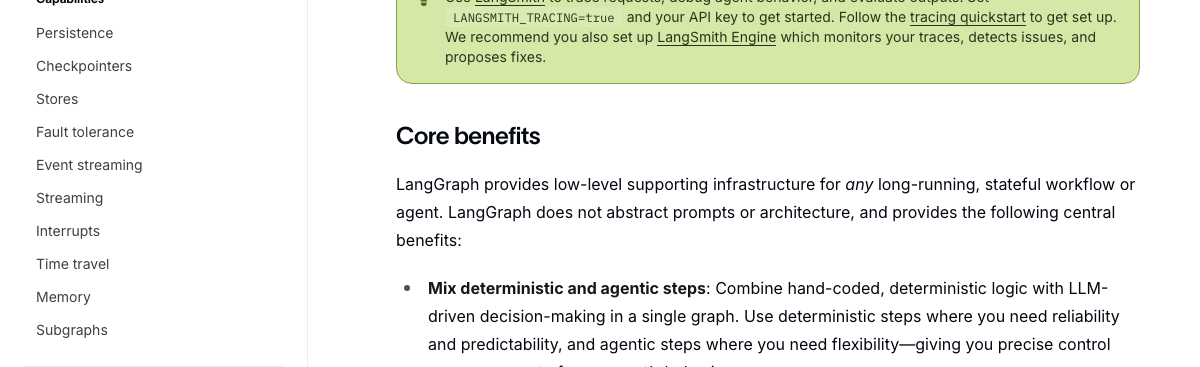
LangGraph is designed as a low-level orchestration framework and runtime for managing long-running, stateful agents. Drawing design inspiration from Pregel and Apache Beam, with an interface influenced by NetworkX, it allows developers to interleave deterministic, hand-coded steps with LLM agentic steps inside a single graph while managing both short-term working memory and long-term session memory.5
AutoGen AgentChat requires Python 3.10 or higher and provides extensions for external communication and code execution. It includes McpWorkbench for interacting with Model-Context Protocol servers and DockerCommandLineCodeExecutor for running model-generated code safely inside a Docker container. For teams managing multi-role workflows, CrewAI allows users to structure sequential, hierarchical, or hybrid processes with guardrails, callbacks, and human-in-the-loop triggers.67
API token economics and tool container infrastructure costs
Agent loops amplify token consumption because every iterative cycle passes conversational history and tool outputs through the model context. Frontier models exhibit substantial pricing differentials across input, cached input, and output tiers.89
| Model Tier | Standard Input (/1M) | Cached Input (/1M) | Output (/1M) |
|---|---|---|---|
| OpenAI GPT-6 Luna | $0.10 | $0.01 | $0.50 |
More on OpenAI GPT-6 Luna
| |||
| OpenAI GPT-6.1 Sol | $2.00 | $0.10 | $10.00 |
More on OpenAI GPT-6.1 Sol
| |||
| OpenAI GPT-6 Astra | $10.00 | $1.00 | $50.00 |
More on OpenAI GPT-6 Astra
| |||
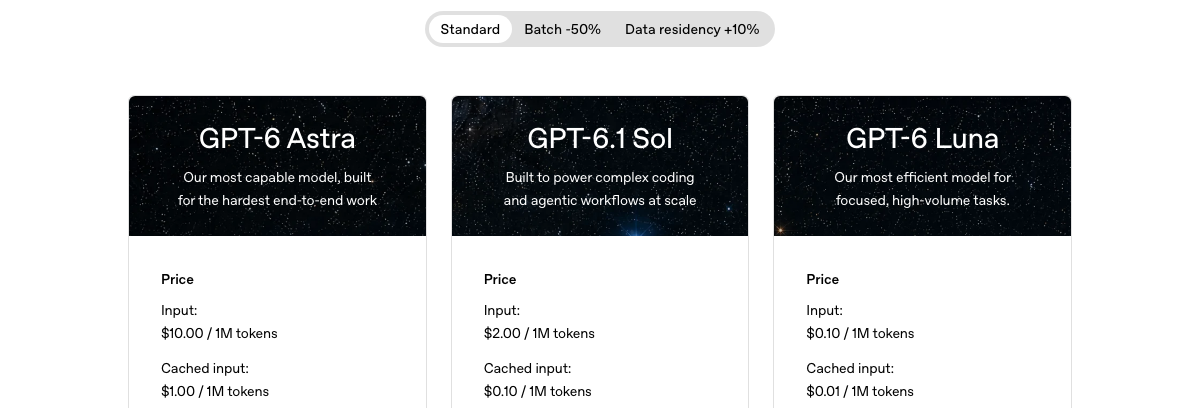
According to our data captured on 2026-10-13, running 1 million input tokens plus 1 million output tokens costs $0.60 on GPT-6 Luna compared to $60.00 on GPT-6 Astra, representing a 100-fold price increase. For secondary tasks like verification or classification, Luna is the cheaper fit, whereas multi-step synthesis often requires Astra's reasoning capabilities at $10.00 per million input and $50.00 per million output tokens.9
Beyond token prices, operational costs include external tool access and container execution. OpenAI charges $10.00 per 1k calls for its web search tool, while search content tokens are free. Dedicated tool execution containers are billed per container at $0.03 for 1 GB up to $1.92 for 64 GB.8
Enterprise seat tiers and unified resource access security
Deploying agentic workflows across internal teams involves dedicated workspace licenses alongside raw API consumption. Anthropic provides Claude Pro at $17 per month with an upfront annual payment of $200, or $20 per month when billed monthly. Claude Max starts at $100 per month and includes $100 to $200 per month in Claude Platform API credits to support development.10
Team tiers split into Claude Team standard seats at $20 per seat monthly on annual billing ($25 monthly) and premium seats at $100 per seat monthly on annual billing ($125 monthly). For larger organizations, Claude Enterprise is priced at US$20 per seat per month billed annually, requiring a 20-seat minimum while API usage scales with model selection and task volume.10
At the infrastructure layer, production runtimes standardize connection security across diverse backends. The SmythOS Runtime Environment (SRE) functions as an open-source runtime and SDK providing unified OS-level abstractions across LLM APIs, vector databases, storage providers, and RAM or Redis caching. To enforce boundary controls, SRE includes a Candidate/ACL system designed specifically to regulate secure resource access across agent tools and data stores.11
Engineering teams implementing autonomous AI agents should decouple deterministic operational flows from probabilistic model calls using runtimes like LangGraph or AutoGen. If an agent task relies primarily on repetitive retrieval and programmatic checks, executing high-frequency iterations on lower-cost tiers like GPT-6 Luna before routing complex edge cases to GPT-6 Astra prevents runaway container and token overhead.5689