 3AM Marketer
AI Agent Orchestration: Topologies, State, and Token Costs
A technical architecture guide comparing centralized Pregel state graphs, peer-to-peer handoffs, BPMN governance, and the 100x token cost spread between agent tiers.
AI agent orchestration manages the interplay between four core autonomous agent components: profile, memory, planning, and action. While basic agent loops rely on sequential interactions between language models and tools, production multi-agent architectures depend on concrete topologies, ranging from centralized state graphs to peer handoffs and parallel pipelines.1
Selecting the right orchestration model directly impacts infrastructure costs and latency. Across the GPT-6 model tier, running a heavy frontier model as an end-to-end controller costs 100 times more than using a lightweight routing model, making topology design a critical financial constraint when teams begin building AI agents with modern frameworks.2
Runtime topologies: Centralized controllers, distributed peers, and parallel pipelines
Orchestrating autonomous agents requires balancing centralized control against distributed autonomy. Centralized orchestration models rely on a primary control layer to direct task assignment and decision flow in one location, handling all routing logic and approval rules before routing execution to worker agents.3
Distributed orchestration allows agents to communicate directly and negotiate task ownership based on context and capability, avoiding the bottleneck of routing every decision through a central controller.3
For latency-critical workflows, parallel orchestration reduces execution time by dispatching independent data extraction or API verification calls at once. When deploying such setups, enterprise platforms often implement execution circuit breakers to prevent runaway recursive tasks across concurrent workers.4
How state graphs, prompt templates, and handoffs execute under the hood
Different frameworks implement execution coordination through distinct runtime primitives. LangGraph models agent workflows as graphs composed of State, Nodes, and Edges. The StateGraph class serves as the primary construction interface, parameterized by a user-defined State object.5
Inspired by Google's Pregel system, LangGraph executes across discrete super-steps using message passing. Nodes running in parallel belong to the same super-step, while sequential nodes execute across separate super-steps. Graph execution terminates when all nodes are inactive and no messages remain in transit.5
LangGraph states can be structured using TypedDict, dataclass, or Pydantic BaseModel, though Pydantic is noted to be less performant than TypedDict or dataclass. In addition to the main shared application state, nodes can declare and write to private internal state channels that remain separate from the public input and output schema.5
In managed cloud environments, Amazon Bedrock Agents Classic has been placed into maintenance mode and succeeded by Amazon Bedrock AgentCore. Bedrock Agents exposes four default base prompt templates for pre-processing, orchestration, knowledge base response generation, and post-processing tasks. The agent generates an observation after invoking an action or summarizing knowledge base results, using that observation to augment its base prompt iteratively.6
In the open-source ecosystem, OpenAI Swarm served as an educational framework focused on lightweight, client-side coordination using two abstractions: Agents and handoffs. Swarm runs statelessly over the Chat Completions API. When an execution transfer occurs via a tool returning an Agent, the active agent's instructions replace the system prompt while chat history remains intact. OpenAI has officially replaced Swarm with the OpenAI Agents SDK for production deployments.7
Structuring prompt boundaries across iterative agent steps also changes completion fidelity. Anthropic documentation notes that placing queries at the end of prompts can improve response quality by up to 30 percent in complex multi-document inputs, demonstrating the importance of orchestration prompt formatting.8
The 100x token cost spread between router agents and frontier executors
Multi-agent systems magnify API expenses because every orchestration hop consumes input and output tokens. Deploying a single frontier model across routing layers and worker tasks generates unsustainable bills. Token pricing across the GPT-6 tier illustrates the financial scale of multi-tier routing.29
| Model Tier | Input per 1M | Cached Input per 1M | Output per 1M |
|---|---|---|---|
| GPT-6 Luna | $0.10 | $0.01 | $0.50 |
More on GPT-6 Luna
| |||
| GPT-6.1 Sol | $2.00 | $0.10 | $10.00 |
More on GPT-6.1 Sol
| |||
| GPT-6 Astra | $10.00 | $1.00 | $50.00 |
More on GPT-6 Astra
| |||
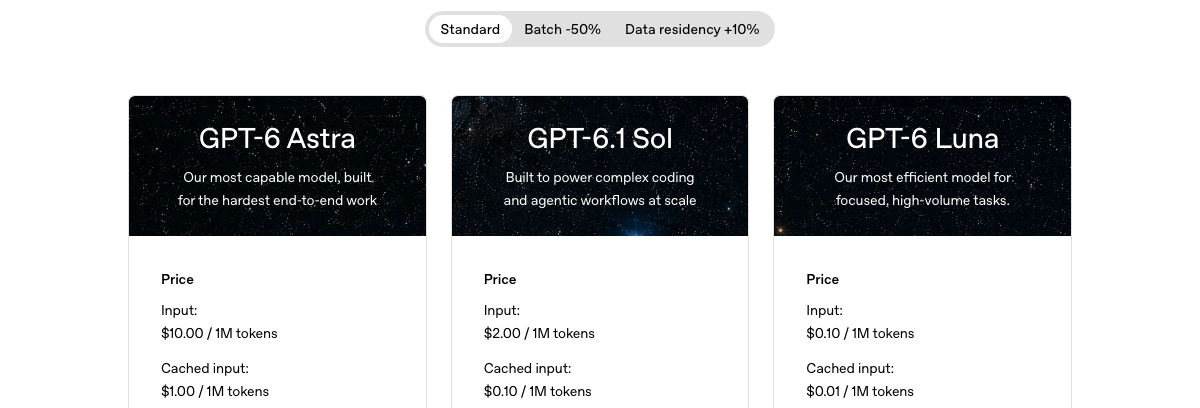
For 1 million input tokens plus 1 million output tokens, GPT-6 Luna costs $0.60 while GPT-6 Astra costs $60.00, representing a 100-fold price spread. Architectures that route classification and tool selection to lightweight models preserve high-margin unit economics, as tracked across published business pricing breakdowns.29
When agents invoke sandboxed environments for code interpretation or containerized execution, compute fees accumulate alongside token billing. OpenAI container execution costs $0.03 for 1 GB and $1.92 for 64GB per container, which transitioned to per 20-minute sessions on March 31, 2026. For asynchronous workflows, OpenAI's Batch API offers a 50% discount on inputs and outputs for tasks completed over 24 hours.9
Governing agentic workflows with BPMN 2.0 and DMN models
Uncontrolled agent autonomy presents compliance hazards when models execute sensitive enterprise tasks. To establish structural guardrails, agentic orchestration platforms incorporate Business Process Model and Notation (BPMN) 2.0 constructs and Decision Model and Notation (DMN) models.10
BPMN 2.0 provides standardized visual and semantic process definitions to organize workflows across autonomous AI agents, legacy RPA bots, and human reviewers. DMN models embed deterministic decision tables within the flow, ensuring rule-based policy compliance executes outside the non-deterministic reasoning loops of LLMs.10
Architect multi-agent deployments around specialized routing. Assign lightweight models like GPT-6 Luna to classify incoming requests and execute deterministic routing decisions, reserving frontier models like GPT-6 Astra strictly for final synthesis. If latency requirements permit asynchronous processing, route non-interactive workloads through the Batch API to immediately cut token expenditure by 50%.9