 3AM Marketer
OpenAI Math Proofs: 722 Manuscripts, Lean Checks, Gaps
OpenAI published 722 mathematical manuscripts evaluated across roughly 4,000 research problems, pairing unreleased model reasoning with a 42% Lean formalization rate.
OpenAI published a GitHub repository on October 6, 2026, containing 722 mathematical research manuscripts produced by an unreleased internal frontier model. The release evaluated approximately 4,000 research problems and organized the resulting findings into 372 result families, backed by formalization code, 10 model reasoning summaries, and computational runtime statistics.12
Inside the October 2026 mathematics repository
The release followed earlier demonstrations, such as a May 2026 disproof of an unsolved 1946 Erdős geometry conjecture and an August 1, 2026 publication titled Ten advances in mathematics and theoretical computer science. To establish publishing guidelines for machine-generated research, OpenAI consulted with the independent Advisory Group on Mathematics and Artificial Intelligence at the Institute for Advanced Study.13
Disproofs, zeta functions, and 17 subject disciplines
The catalog distributes its 372 result families across 17 mathematical disciplines. Theoretical computer science accounts for the largest share with 40 result families, combinatorics follows with 37, and algebraic and complex geometry comprises 36. An external analysis estimated that approximately 20% of the published outputs are counterexamples or disproofs rather than affirmative constructions.24
The collection exhibits notable structural boundaries and gaps. Result family IDs reach a ceiling of 377 while skipping IDs such as 123 and 163. Within Family 003, the manuscripts do not claim a solution to the full Riemann Hypothesis; instead, the primary paper establishes a zero-free region for Dirichlet L-functions and the Riemann zeta function in the half-plane Re(s) > 7/8, while a companion paper provides an alternate argument establishing a zero-free region for Re(s) > 11/12.4
Where machine verification held up and where proofs broke
The repository pairs natural-language manuscripts with machine verification in Lean, but errors still got through. On October 7, 2026, OpenAI withdrew three manuscripts after discovering a sign error that invalidated a stabilization-trace cancellation argument.5
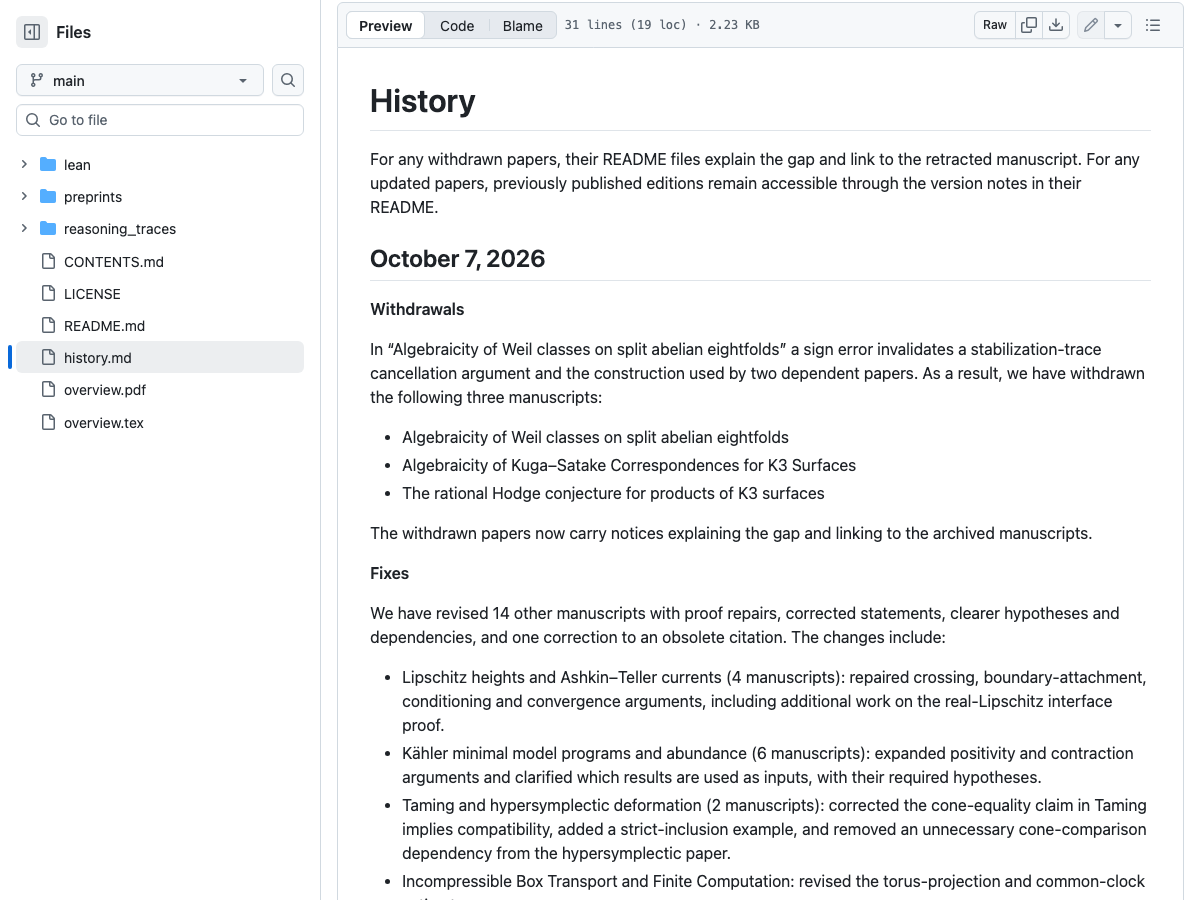
Alongside the three retracted geometry manuscripts, OpenAI revised 14 other manuscripts on October 7 with proof repairs and corrected statements, while correcting citations across 13 companion manuscripts. Following these revisions, the verified count settled at 300 out of 719 top-line results formalized in Lean, establishing a formal verification rate of roughly 42%.5
Measuring the compute cost of automated proof generation
OpenAI reported operational expenditures in consumer platform terms, stating that producing an average mathematical result consumed compute roughly equivalent to three hours of ChatGPT Pro thinking.12