 3AM Marketer
Multimodal AI App Architecture: 2026 Model Costs
A technical and financial breakdown for deploying multimodal AI apps in 2026, comparing OpenAI GPT-6 and Gemini pricing, Claude image limits, and batch discounts.
Production deployments for a multimodal AI app require balancing input token rates across text, vision, and execution environments while planning for scheduled model price increases. In late 2026, baseline multimodal input costs range from $0.10 per million tokens on lightweight models like OpenAI GPT-6 Luna up to $10.00 per million tokens on frontier models like OpenAI GPT-6 Astra.1
Over 90% of CIOs report that cost management limits their ability to derive enterprise value from AI workloads. Scaling vision pipelines across high-resolution image inputs and execution sandboxes rapidly compounds token expenses, making an accurate total cost of ownership model essential before release.2
The $10.89 billion multimodal landscape and model pricing
The global multimodal AI market is projected to reach a valuation of $10.89 billion by 2030. To capture that growth, engineering teams are transitioning away from text-only pipelines into architectures that process text, visual media, and code simultaneously, often connecting workflows into an autonomous AI agents runtime.3
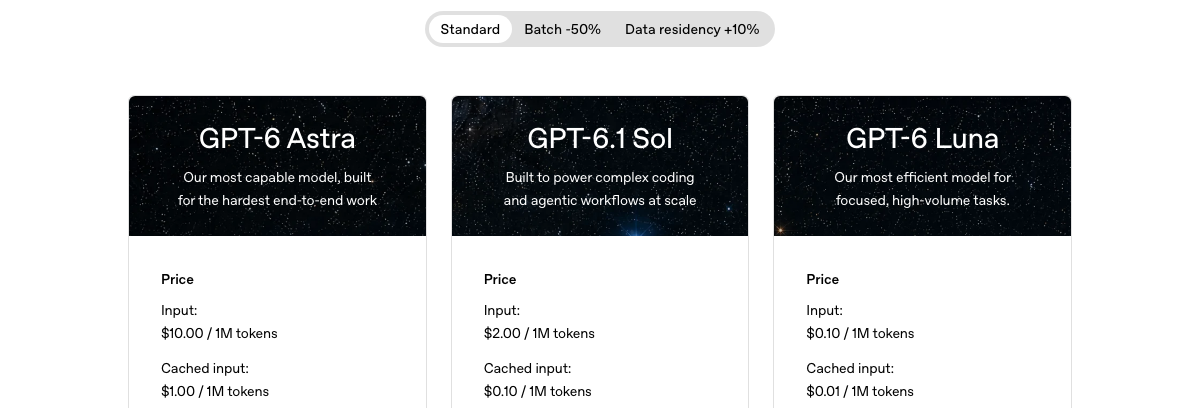
Token accounting for multimodal inputs differs fundamentally by tier. In OpenAI's GPT-6 generation, GPT-6 Astra serves frontier end-to-end tasks at $10.00 per 1 million input tokens and $50.00 per 1 million output tokens, with cached inputs priced at $1.00 per 1 million tokens. GPT-6.1 Sol addresses agentic workflows and coding at $2.00 per 1 million input tokens ($0.10 cached) and $10.00 per 1 million output tokens. GPT-6 Luna targets high-volume utility at $0.10 per 1 million input tokens ($0.01 cached) and $0.50 per 1 million output tokens.1
For historical context on API efficiency curves, earlier generation models such as OpenAI GPT-5 carried input costs of approximately $1.25 per 1 million tokens, while GPT-5 Mini stood at approximately $0.25 per 1 million input tokens. Because one million tokens equals roughly 750,000 words of text, vision payloads involving multi-image frames consume equivalent token allocations significantly faster.2
Comparing model tiers and scheduled price increases
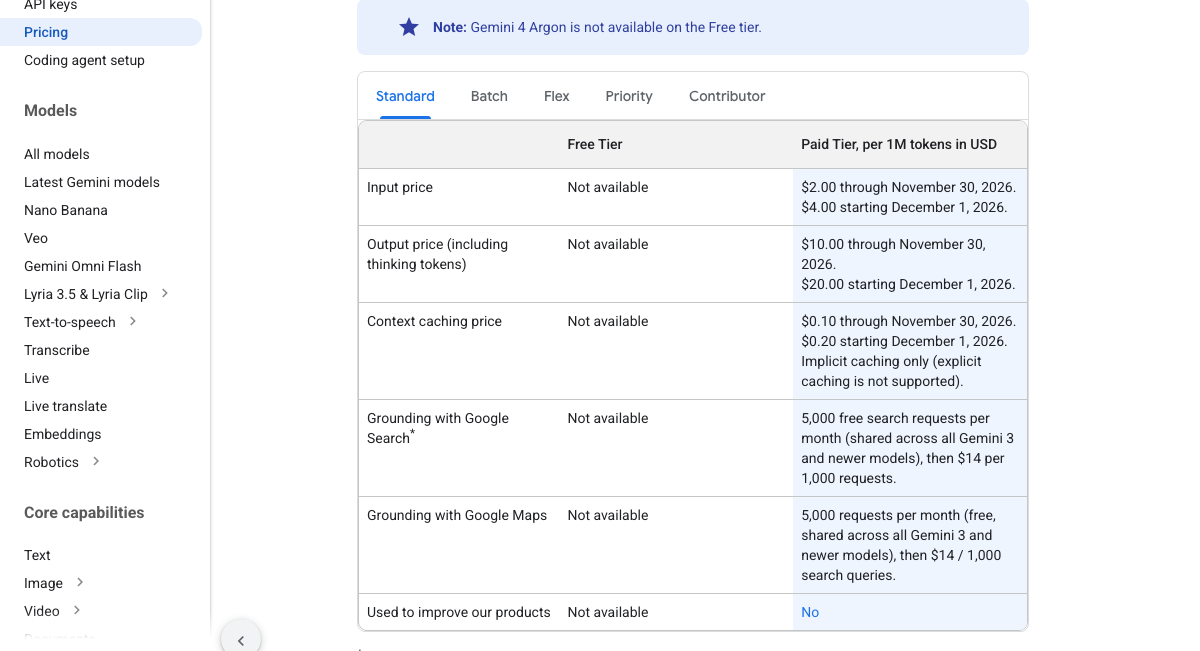
Production roadmaps must account for contractual price increases scheduled for late 2026 and early 2027. Google's Gemini Developer API features scheduled rate shifts that double token pricing on key models, an important factor when analyzing our LLM API pricing timeline.4
Through November 30, 2026, Gemini 4 Argon costs $2.00 per million input tokens and $10.00 per million output tokens, including thinking tokens. Starting December 1, 2026, Gemini 4 Argon input rates increase to $4.00 per million tokens and outputs rise to $20.00 per million tokens. Similarly, Gemini 3.8 Flash costs $0.75 per million input tokens and $3.75 per million output tokens through December 31, 2026, before increasing to $1.50 per million input tokens and $7.50 per million output tokens on January 1, 2027.4
| Model Tier | Input Rate / 1M Tokens | Output Rate / 1M Tokens | Scheduled Rate Adjustments |
|---|---|---|---|
| OpenAI GPT-6 Astra | $10.00 ($1.00 cached) | $50.00 | Current 2026 baseline |
More on OpenAI GPT-6 Astra
| |||
| OpenAI GPT-6.1 Sol | $2.00 ($0.10 cached) | $10.00 | Current 2026 baseline |
More on OpenAI GPT-6.1 Sol
| |||
| OpenAI GPT-6 Luna | $0.10 ($0.01 cached) | $0.50 | Current 2026 baseline |
More on OpenAI GPT-6 Luna
| |||
| Gemini 4 Argon | $2.00 | $10.00 | Increases to $4.00 in / $20.00 out on Dec 1, 2026 |
More on Gemini 4 Argon
| |||
| Gemini 3.8 Flash | $0.75 | $3.75 | Increases to $1.50 in / $7.50 out on Jan 1, 2027 |
More on Gemini 3.8 Flash
| |||
Technical limits across Claude vision and container runtimes
Architectures implementing what multimodal generative AI refers to in production must operate within strict API payload boundaries. Anthropic imposes distinct vision constraints: API requests are limited to 100 images per request for models with a 200k-token context window, and 600 images per request for all other models.56
Claude vision inputs have strict resolution and payload thresholds. The maximum dimensions for each image uploaded to Claude are 8000x8000 px, and the maximum file size per image is 10 MB when base64-encoded on the Claude API and Claude models on Google Cloud.6
Multimodal applications deploying isolated sandbox code execution also face container charges. OpenAI container pricing is billed per 20-minute session per container: $0.03 for 1 GB instances and $1.92 for 64 GB instances.1
For developer prototyping environments, subscription tiers tracked in our pricing set include Claude Pro at $20 monthly ($17 billed annually), Claude Max at $100 monthly, and Claude Team seats from $20 to $100 monthly per seat billed annually. Claude Free remains $0 a month billed monthly, while Claude Team Standard is $25 monthly and Claude Team Premium is $125 monthly when billed month-to-month.7
Batch processing and cost-optimization strategies
Production architectures handling asynchronous image ingestion can achieve major cost reductions using dedicated queue endpoints. OpenAI offers a 50% discount on inputs and outputs when using the Batch API, which processes workloads asynchronously over a 24-hour delivery window.1
Grounding multimodal answers with live web data introduces additional query costs unless allowances are factored in. Developers building on the Gemini API receive 5,000 free search requests per month for grounding with Google Search, shared across Gemini 3 and newer models, after which grounding is billed at $14 per 1,000 requests.4
For enterprise teams evaluating whether to build self-hosted multimodal infrastructure, the financial hurdles remain steep. Training frontier foundation models at the GPT-4 scale costs between $41M and $78M, with major releases reaching upwards of $200M+. While training smaller models of a few hundred million to a few billion parameters costs $50K to $1M on rented GPU clusters, and mid-sized ~70B parameter models run between $1M and $6M, self-hosted inference clusters burn GPU compute at $2-3/hour per H100. Teams running dedicated capacity use Reserved Instances and Savings Plans to cut baseline GPU compute costs by 30-50%, while optimized serving stacks like TrueFoundry report handling 350+ requests per second on 1 vCPU without manual tuning.289
To protect unit economics, audit your current token throughput before the December 1, 2026 Gemini price increases take effect. Transition large-scale, asynchronous image processing pipelines over to the OpenAI Batch API to secure the 50% token rate reduction, resize input image payloads below 8000x8000 px and 10 MB, and lock in cached token prompts on high-frequency routing paths.146