 3AM Marketer
EmbeddingGemma 2: Modular 740M Multimodal Specs
Google DeepMind released EmbeddingGemma 2 under Apache 2.0, offering a modular 740M parameter architecture that compresses vectors up to six times and runs within 191MB to 567MB of RAM.
Google DeepMind released EmbeddingGemma 2 under an Apache 2.0 license, providing a 740 million total parameter architecture that runs locally across text, code, audio, and video without an API key. Built on the Gemma 4 framework, the model expands token context to an 8K window that ingests up to 5.5 minutes of audio, 29 images, or 58 video frames.123
The release shifts on-device retrieval away from single-modality setups. Across more than 100 languages, queries execute in roughly 20 to 70 milliseconds using WebGPU inside standard browsers, allowing developers to deploy offline retrieval pipelines on consumer hardware without sending data to external endpoints.234
Inside the 740M modular architecture
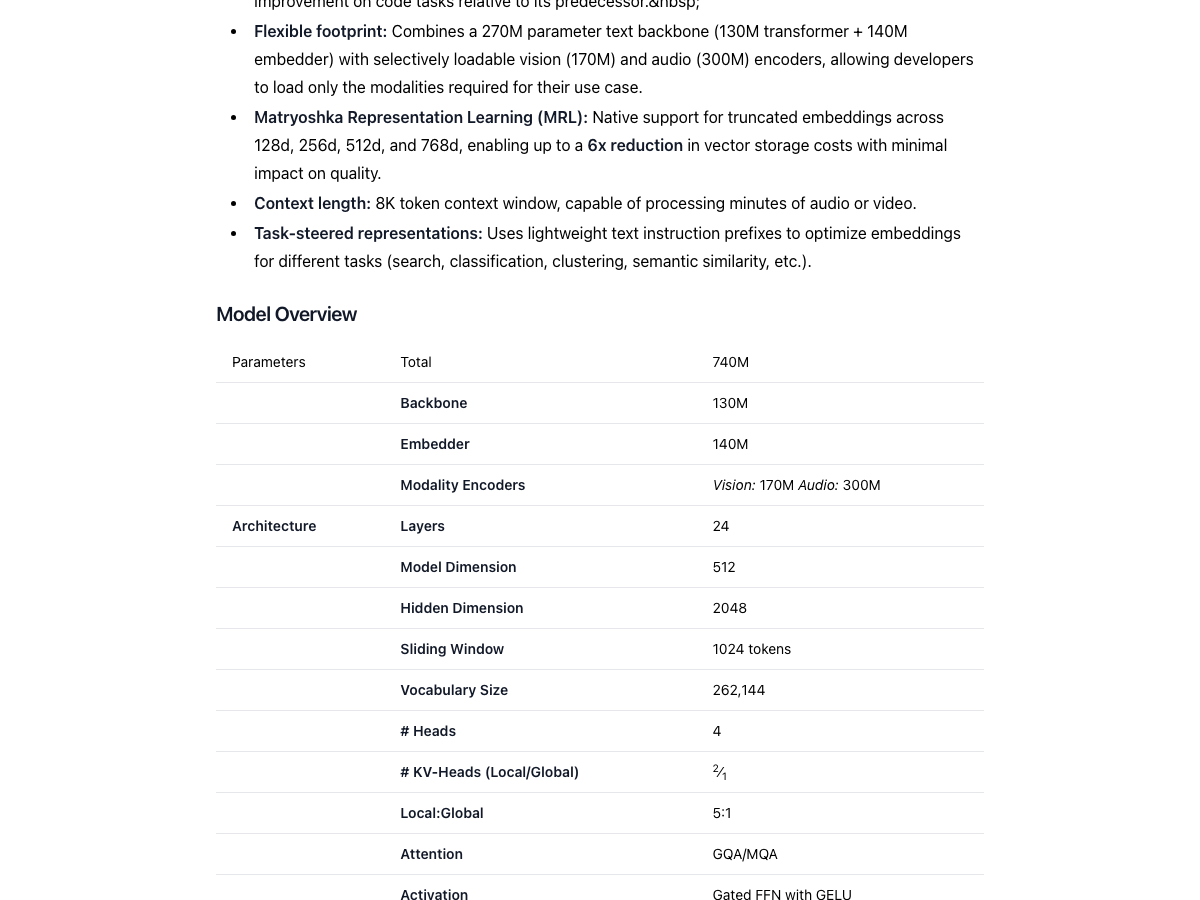
EmbeddingGemma 2 uses a modular design rather than forcing teams to load a monolithic weights file. The text backbone requires 270 million parameters, divided into a 130M transformer and a 140M embedder, while vision adds 170 million parameters and audio adds 300 million parameters. In BF16 format, the complete Safetensors file contains 744,371,512 parameters and measures 1,488,915,288 bytes on disk.14
The model structure contains 24 layers, a base model dimension of 512, a hidden dimension of 2,048, and an internal projection layer scaling embeddings from 512 to 768 dimensions. EmbeddingGemma 2 shares its text tokenizer and audio encoder with Gemma 4, allowing engineers evaluating local AI models to pair embedding and generation tasks in unified pipelines with a lower shared memory footprint. From our data, Google released companion base systems like gemma-4-12B under Apache 2.0 on 2026-05-23.156
Cutting storage costs with Matryoshka truncation
EmbeddingGemma 2 integrates Matryoshka Representation Learning, allowing practitioners to truncate vector outputs from the native 768 dimensions down to 512, 256, or 128 dimensions. This technique cuts local vector database storage requirements by up to 6 times, at the cost of retrieval quality shown below.15
| Dimensions | Compression ratio | MMEB v2 Image (Hit@1) |
|---|---|---|
| 768d | 1:1 | 57.28 |
| 256d | 1:3 | 56.24 |
| 128d | 1:6 | 45.65 |
Benchmark scores across code and media
Across multi-modal evaluation suites, the architecture achieves a 9.92-point increase on MTEB Code, climbing to 78.68 compared to 68.76 for EmbeddingGemma 1. On MTEB multilingual v2 at full 768 dimensions, EmbeddingGemma 2 scores 61.36, improving slightly over the 61.15 mark posted by EmbeddingGemma 1.15
Media evaluations show 64.64 on MIEB lite, 57.28 on MMEB v2 Image Hit@1, and 67.84 on MMEB v2 VisDoc NDCG@5. For video and audio sequences, EmbeddingGemma 2 records 50.67 on MMEB v2 Video Hit@1, 69.54 on MSEB Retrieval MRR@10, and 49.39 on MAEB.5
Hardware footprints and the float16 constraint
On physical hardware, active memory demands remain low. In Google's measurements on a Pixel 11 Pro, text-only execution requires approximately 191MB of active RAM, while running the complete multimodal stack uses approximately 567MB. Weights are distributed publicly through Hugging Face and Kaggle.12
For teams deploying privacy-first search, select the 270M text module when media indexing is unnecessary, and maintain BF16 precision across local runtimes to prevent the degradation that occurs under standard float16 math.17