 3AM Marketer
DeepSeek V4.1 Flash Delivers 208.7 Tokens per Second
DeepSeek released V4.1 Flash under the MIT license, combining 208.7 tokens per second output speed with steep API price cuts and a 1M token context window.
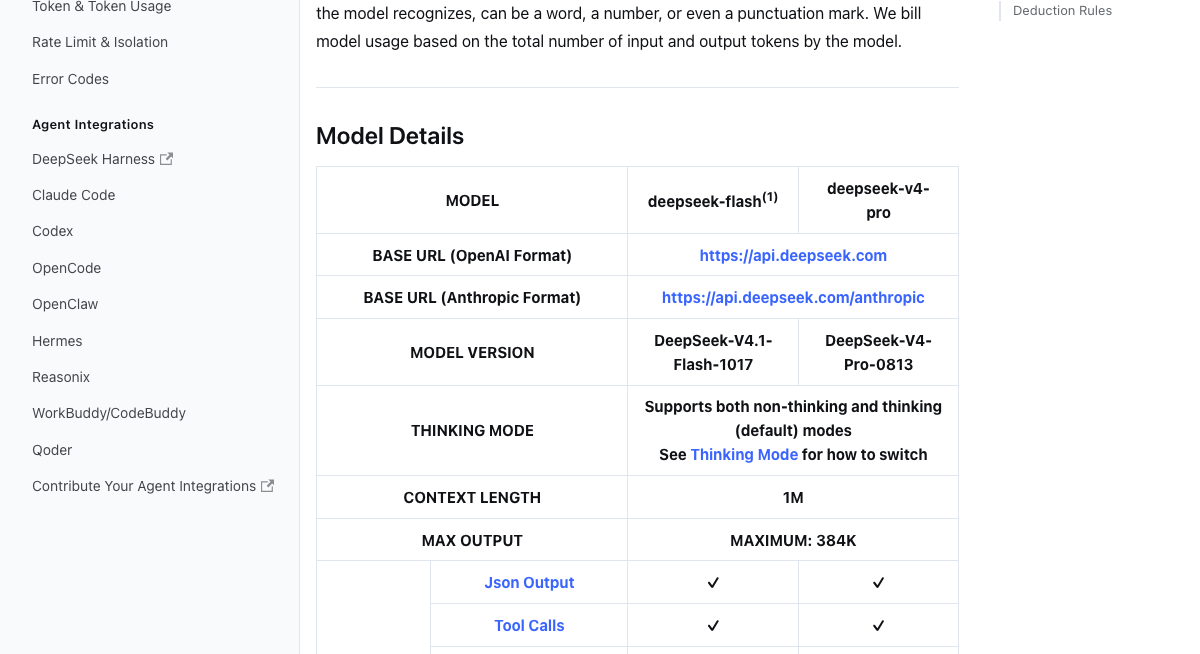
DeepSeek released DeepSeek V4.1 Flash on September 10, 2026, generating an average output speed of 208.7 tokens per second and cutting cache-miss input costs by about 77 percent compared to V4 Pro. The model is released under an MIT license with a 1M tokens context window and a maximum output limit of 384K tokens.123
DeepSeek's pricing page says requests to the retired deepseek-v4-flash names are now served by V4.1 Flash and billed at the Flash price, while deepseek-v4-pro keeps its own rates. The release supports both text and image inputs while establishing a 2,500 concurrency limit on the official DeepSeek API.14235
Causal encoder-decoder architecture cuts KV cache to 890 bytes
The model architecture separates input ingestion from generation. Built as a 552B total parameter model, V4.1 Flash activates 8 billion parameters per token for reading input context and 16 billion active parameters for generating text. In our tracking of the open model release tracker, V4.1 Flash registers a combined parameter footprint of 763.2B parameters.42165
DeepSeek reduced the global KV cache per token to 890 bytes, making it approximately 75 percent smaller than V4 Flash. Compared to its predecessor, V4.1 Flash requires about one quarter of the high-bandwidth memory (HBM) and one eighth of the persistent SSD storage. Alongside the model weights, DeepSeek published DeepInfer, its internal inference stack estimated to yield up to a 90% gross margin when serving tokens.145
API pricing cuts token costs with 98 percent prompt caching
According to our LLM API pricing timeline, standard peak rates for deepseek-flash sit at $0.30 per million non-cached input tokens and $1.20 per million output tokens, compared to $1.32 input and $3.96 output for deepseek-v4-pro. For 1 million input plus 1 million output tokens, deepseek-flash totals $1.50, whereas deepseek-v4-pro costs $5.28, which is 3.5 times as much.73
Peak API hours span 01:00 to 04:00 and 06:00 to 10:00 UTC Monday through Friday, excluding Chinese public holidays. During off-peak windows, cache-miss inputs drop to $0.15 per million and outputs fall to $0.60 per million. The platform provides a 98% prompt caching discount, driving cache-hit input costs down to $0.006 per million during peak hours and $0.003 off-peak. Third-party provider OpenRouter lists the model at $0.056 per million input tokens and $0.12 per million output tokens. Standalone Search and Fetch APIs cost $0.75 per 1,000 successful requests, with per-request billing starting on November 1, 2026.328
Benchmarks show 74.2 on DeepSWE and coding gains
On Artificial Analysis, DeepSeek V4.1 Flash scored 45 on the Intelligence Index, exceeding the index median of 19, with an average evaluation cost of $0.26 per task.2
Terminal-Bench 4.0 climbed from 7.0 on V4 Flash to 31.2 on V4.1 Flash, and DeepSWE v1.1 increased from 54.4 to 74.2. On Terminal-Bench 2.1, V4.1 Flash scored 90.6 against 87.9 for V4 Pro. Across eight agent scaffolds, V4.1 Flash's DeepSWE v1.1 results ranged from 65.5 on OpenCode to 74.2 on mini-SWE. However, V4 Pro retains higher scores on raw knowledge: GPQA Diamond reached 92.4 for V4 Pro versus 90.9 for V4.1 Flash, Humanity's Last Exam text-only without tools scored 42.7 versus 39.1, and SimpleQA-Verified recorded 55.2 for V4 Pro Base against 42.3 for V4.1 Flash Base.1
Procurement restrictions affect federal enterprise deployments
Deploying V4.1 Flash involves navigating expanding regulatory restrictions. The Department of Homeland Security issued an order, originally enacted on July 24 and made public in October 2026, restricting DeepSeek as a company and its models as a technology platform from federal civilian procurement. The ban requires federal civilian agencies, including Treasury, State, and Justice, to remove DeepSeek-related technologies from their IT systems, covering third-party products and services built with the models, while excluding the Department of Defense.59


For organizations consuming models via Snowflake, Vercel, or OpenRouter, federal compliance boundaries require verifying that downstream workflows and third-party integrations do not cross into civilian agency supply chains subject to the DHS order.109