 3AM Marketer
AI Powered Workflow Automation Platform Guide: Pricing
Choosing an AI-powered workflow automation platform comes down to metering mechanics: Zapier pools shared tasks, Make tracks operations credits with zero-cost routing, and n8n bills per execution.
Choosing an AI powered workflow automation platform comes down to how each engine meters execution, throttles long-running models, and bills high-volume runs. Activepieces, which sells a competing tool, estimates that 100,000 monthly tasks cost about $700 on Zapier and $199.99 on Make, 71% less, while self-hosted n8n removes task-based billing entirely.1
The operational divide between Zapier, Make, and n8n is rooted in their billing units. Teams building autonomous AI agents with runtimes and loops face distinct trade-offs between Zapier's shared task pools, Make's credit-based model, and n8n's step-independent execution structure.12
Which platform fits your workflow model?
Zapier links over 9,000 apps and offers a Free tier with 100 tasks per month, starting Professional plans at $19.99 per month and Team tiers at $69 per month for 25 users. Annual billing cuts these list prices by 33%. Our data tracked Zapier Free, Zapier Agents Free, and Zapier Chatbots Free at $0 a month billed monthly in October 2026. However, its polling intervals drop from 15 minutes on Free to 2 minutes on Professional, reaching 1 minute on Team and Enterprise.23
Make structures access around monthly operations credits. Its Free tier provides 1,000 credits per month with 1 MB of data storage and 1 data store. For qualifying companies with under 20 employees, Make's Start-up Plan gives 50% off the Business plan.4
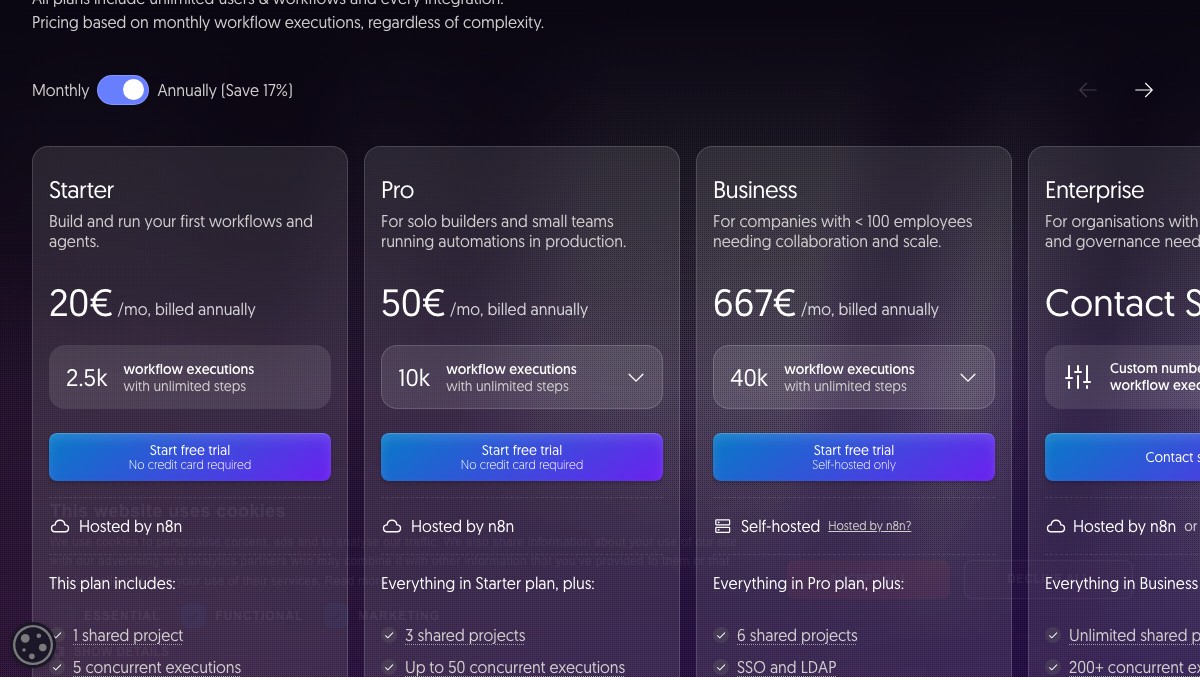
Cloud-hosted n8n bills by execution rather than step count. The Starter tier costs 20€ per month billed annually for 2.5K workflow executions with unlimited steps and 5 concurrent executions, while Pro provides 10,000 executions and up to 50 concurrent executions for 50€ per month billed annually. Larger setups can use Business at 667€ per month billed annually for 40K workflow executions, backed by a 17% annual billing savings across plans.5
How execution metering changes your AI pipeline costs
Zapier handles multi-step AI flows by drawing AI steps, code scripts, and SDK execution from a unified task pool. Consumption within that pool is not fixed: actual task usage rates scale based on the AI model tier invoked, code runtime, and connector type. A single run executing three LLM evaluations and custom formatting scripts burns multiple tasks from your allowance.2
Make now uses credits as its primary billing unit. Most standard actions consume 1 credit, but advanced operations running Make's internal AI Provider consume more. Crucially, Make does not charge credits for Router modules or error handlers such as Rollback, Break, Resume, Commit, and Ignore, keeping branching conditional logic free.4
In n8n, an execution represents a single run of an entire workflow regardless of how many steps run or how much payload data passes through. An agent looping through multiple tool checks and database mutations still logs as one execution. Because every run counts toward your execution cap on cloud tiers, high-frequency polling schedules consume your monthly allowance whether new items exist or not.5
The $199.99 vs $700 tipping point at high volume
Volume scaling exposes the cost differences between per-task, credit, and per-execution billing. By Activepieces' estimate, a team running 100,000 monthly tasks pays about $700 on Zapier and $199.99 on Make, 71% less. Understanding these thresholds prevents surprise overages when scaling AI agent orchestration and token state.1
Self-hosted n8n alters the equation by allowing unlimited execution volume constrained only by your underlying server hardware. Deploying self-hosted n8n sidesteps per-task and per-execution overage tiers entirely, though teams must manage server maintenance and database storage.1
| Platform | Starting Tier | Base Price | Included Volume | Metering Model |
|---|---|---|---|---|
| Zapier | Professional | $19.99 /month | Plan dependent | Unified shared task pool varying by model tier & runtime |
More on Zapier
| ||||
| Make | Free | Free tier | 1000 credits per month | Most actions consume 1 credit; Router and Error handlers count no credits |
More on Make
| ||||
| n8n Cloud | Starter | 20€ /mo (annual) | 2.5K executions | Per execution run with unlimited steps |
More on n8n Cloud
| ||||
BYOK and model economics from GPT-6 Luna to Astra
Relying on bundled platform credits for frontier LLMs quickly inflates operating expenses. Zapier reserves Bring Your Own Model functionality exclusively for its Enterprise plan, which also adds custom data retention and annual task limits. In contrast, self-hosted n8n includes its Assistant feature under a bring-your-own-key model without credit caps.26
When connecting custom API keys, raw model pricing dictates pipeline operating costs. Standard OpenAI pricing lists GPT-6 Astra at $10.00 per 1M input tokens ($1.00 cached) and $50.00 per 1M output tokens. For mid-tier routing, GPT-6.1 Sol costs $2.00 per 1M input tokens ($0.10 cached) and $10.00 per 1M output tokens. For focused, high-volume tasks, GPT-6 Luna runs at $0.10 per 1M input and $0.50 per 1M output tokens.6
If an automation handles asynchronous background processing, OpenAI's Batch API provides a 50% discount on inputs and outputs across a 24-hour delivery window. Workflows that retrieve live web sources incur an additional $10.00 per 1k calls for Web search, while search content tokens remain free.67
Runtime timeouts, storage caps, and retention limits
Technical ceilings shape how complex your agent chains can become before timing out. Code by Zapier steps enforce strict execution limits: 1 second on Free, 30 seconds on Professional and Team, and 2 minutes on Enterprise. Zapier Tables limits persistent storage to 2,500 records on Free, 100,000 on Professional, and 500,000 on Team per account.2
Make allocates infrastructure entitlements per 10,000 licensed monthly operations: 5 GB data transfer, 10 MB data storage, 10 MB incomplete executions store (capped at 2 GB maximum), and a webhook queue size of 667 (up to 10,000 maximum). Data stores are capped at 1,000 per organization regardless of plan, with a minimum size of 1 MB each. Extra credits sell in bundles of 1,000 or 10,000, and unused credits expire at the end of the subscription period.4
On n8n Cloud, maximum execution duration is capped at 5 minutes on Starter and 40 minutes on Pro and Enterprise tiers. Saved-execution storage scales from 2.5 GB on Starter to 25 GB on Pro and 50 GB on Enterprise, while execution logs are retained for 7 days on Starter, 30 days on Pro, and unlimited on Enterprise. In self-hosted environments, n8n prunes execution logs once records exceed 336 hours (14 days) or count past 10,000, enforcing a 1-hour hard-delete safety buffer.58
Select Zapier when your architecture depends heavily on native integrations across its 9,000 apps and your workflows run short, linear steps with webhook triggers. Move to Make when your pipelines require heavy conditional routing and error handling without per-branch penalties. For multi-step agent loops, long-running batch extraction, or operations exceeding 100,000 tasks, deploy self-hosted n8n with direct BYOK model routing to keep execution costs independent of workflow depth.1245